
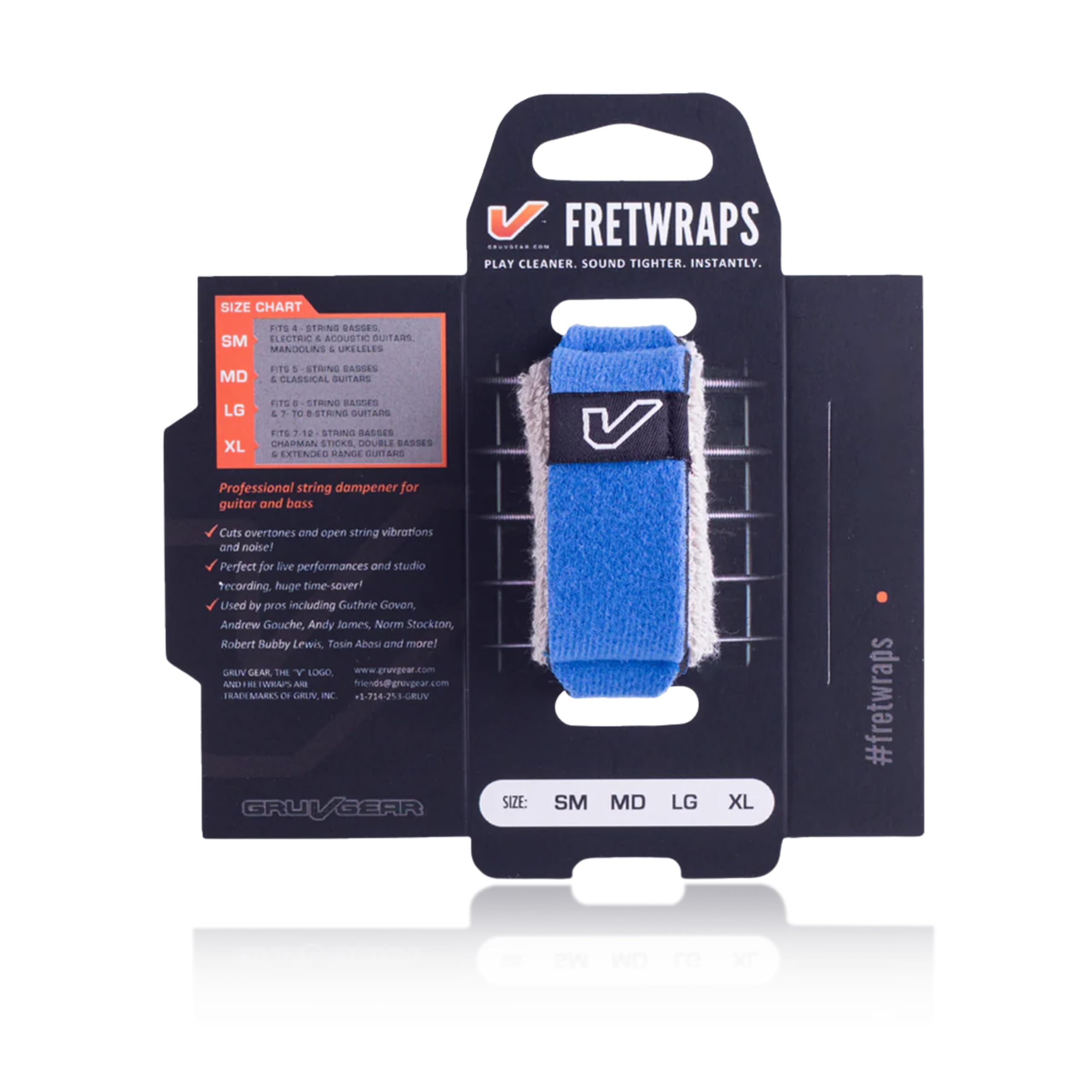
The Gruv Gear Fret Wrap is a simple accessory designed to mute strings behind the nut or bridge, primarily used for recording, tapping, or practice sessions. It’s essentially a padded strap that wraps around the guitar neck, applying gentle pressure to stop unwanted string vibrations. While it’s not a revolutionary tool, it does its job reliably for a specific set of tasks.
In real-world use, the Fret Wrap shines during recording sessions where string noise—like sympathetic vibrations or ringing harmonics—can ruin a clean take. It’s also handy for tapping techniques, where you want to mute strings that aren’t being played to avoid accidental noise. For practice, it can help isolate notes or chords by dampening overtones, which is useful for focusing on articulation. The medium blue version tested here fits 5-string basses and 7-string guitars, but it also works on standard 6-string electrics and acoustics, though the fit is snugger on thinner necks.
- Material and Build: The wrap is made from a stretchy, breathable fabric with a soft inner padding that feels comfortable against the neck. The Velcro closure is sturdy and allows for quick adjustment, though the adhesive on the Velcro can weaken over time with heavy use.
- Adjustability: You can slide it up or down the neck to control how much pressure is applied. This lets you fine-tune the muting effect—from light dampening to near-complete silence behind the nut.
- Compatibility: It works on most fretboards, but the medium size may be too loose on thin necks (like some Ibanez models) or too tight on thick basses. The fit is decent for standard electrics, but you may need to test the tension to avoid unwanted buzz.
One limitation worth noting is that the Fret Wrap isn’t a perfect solution for all muting needs. It primarily dampens strings behind the nut, but it doesn’t eliminate noise from the bridge or body. For players dealing with heavy palm-muting issues or low-string rattle, a more comprehensive mute system (like a hair tie or foam under the strings) might work better. Additionally, the wrap can occasionally slide out of place during aggressive playing, requiring readjustment. The Velcro also tends to collect lint and dust over time, which can reduce its grip—a minor annoyance but worth considering for long-term use.
Compared to alternatives like a simple hair tie or a rubber band, the Gruv Gear Fret Wrap offers a more polished, adjustable experience. Hair ties are cheaper and work in a pinch, but they don’t provide consistent pressure or the ability to fine-tune the dampening. On the other hand, dedicated string muters like the FretWedge or foam-based muters are more permanent solutions for specific instruments, while the Fret Wrap is portable and can be swapped between guitars quickly. For home studio use, the wrap is a convenient tool, but it’s not a substitute for proper technique or a well-setup instrument.
Who is this product for? It’s ideal for recording guitarists who need to clean up takes quickly, especially for tapping or legato passages. It’s also useful for bassists who want to mute behind the nut during slapping or popping. For practice, it helps players focus on note clarity by reducing unwanted overtones. However, it’s not suitable for live performance where you need quick access to open strings, as the wrap can muffle them unintentionally. It’s also overkill for beginners who are still developing basic muting technique—a simple piece of foam or tape might suffice. The price point (around $15–20) is reasonable for what it offers, but it’s not a must-have for every guitarist.