
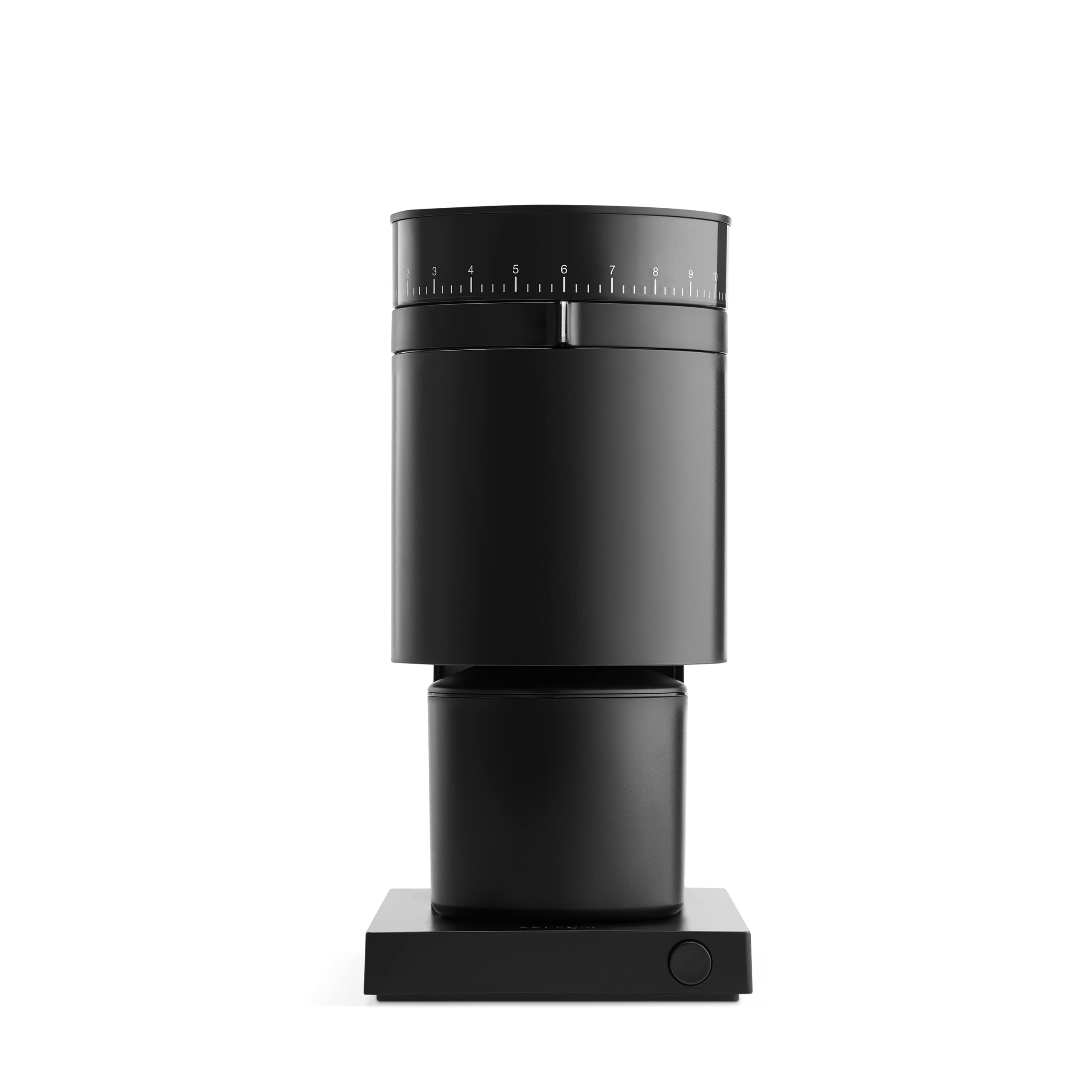
The Fellow Opus Conical Burr Coffee Grinder sits in a crowded segment of home electric grinders, aiming to bridge the gap between entry-level and enthusiast-grade equipment. After spending a few weeks using it for everything from espresso to cold brew, it’s clear this machine has a specific set of strengths and a few notable trade-offs that matter depending on your coffee routine.
Out of the box, the Opus is compact and solidly built. Its matte black finish and angular design fit well on a counter without taking up excessive space. The 40mm stainless steel conical burrs are the core of the grinder, and they do a respectable job producing consistent particle sizes across the 41 adjustment settings. That range is one of its key selling points—it covers fine espresso grinds all the way to coarse French press and cold brew. In practice, switching between brew methods is straightforward once you understand the dual-ring adjustment system. The outer ring handles macro changes, while an inner ring fine-tunes the micro settings. It’s not as intuitive as a stepless grinder, but after a few uses, the process becomes routine.
For real-world use, the Opus performs well with medium-roast beans for drip coffee and pour-over. The grind consistency is noticeably better than blade grinders, and you’ll get a cleaner extraction with fewer fines. For espresso, it’s a mixed bag. At the finest settings, the grinder can produce a fine enough grind for pressurized baskets or beginner espresso machines. However, for more serious espresso setups with non-pressurized baskets, the steps between settings can feel a bit wide. You might find yourself between the perfect dose and slightly too fine or too coarse, requiring some trial and error. This isn’t unusual at this price point, but it’s a limitation to consider if you’re chasing precise espresso shots.
One area where the Opus stumbles is retention. Like many single-dose grinders in this class, it holds onto a small amount of grounds after each use—typically around 0.5 to 1 gram. This isn’t a dealbreaker for most home users, but if you’re switching between different beans regularly, it means the first few grams of your next grind are actually leftover from the previous batch. The included bellows help blow out some of that retained coffee, but it’s not perfect. Cleaning the burrs is straightforward, though the grinder does require occasional disassembly to keep performance consistent.
Noise level is moderate—not silent, but quieter than many comparably priced grinders. The grinding process takes about 20 to 30 seconds for a typical 18-gram dose, which is reasonable. Static cling can be an issue, especially in dry climates; the catch cup is magnetic and fits well, but you’ll likely see some fines sticking to the sides. A quick spritz of water on the beans before grinding helps reduce this.
Compared to a hand grinder like the 1Zpresso J-Max or a more expensive electric option like the Baratza Sette 270, the Opus offers convenience and a broader grind range but sacrifices some precision at the espresso end. It’s a good middle-ground choice for someone who makes a variety of brew styles and doesn’t want to invest in multiple grinders. For dedicated espresso enthusiasts who want stepless adjustment and minimal retention, a hand grinder or a higher-tier electric model might be a better fit.
Who is the Fellow Opus for? It suits home users who brew a mix of drip, pour-over, and occasional espresso with a machine that uses pressurized baskets. It’s also a solid upgrade from blade grinders for anyone wanting more consistency. It is less suitable for those who only drink espresso with a high-end machine, or for anyone who needs to grind very large batches at once—the 100-gram hopper is fine for single doses but not bulk grinding.
Ultimately, the Fellow Opus delivers on its promise of versatility. It’s not flawless, but for its price, it offers a well-rounded set of features that many home brewers will find useful. Just go in knowing that espresso precision has limits, and you’ll likely be satisfied with what it does well.