
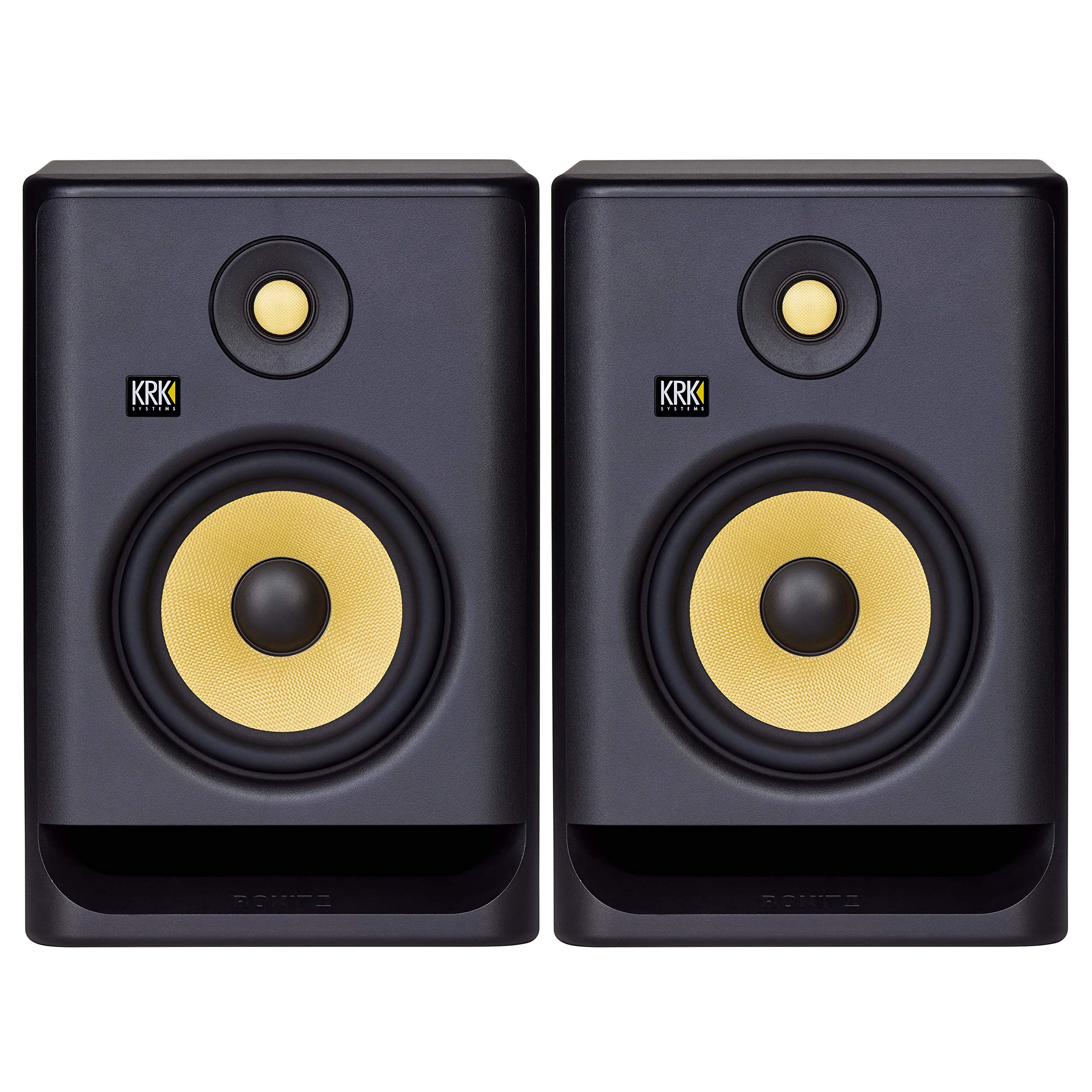
The KRK Rokit 7 G4 monitors have been a staple in project studios for years. This bundle includes a pair of the 7-inch models, which are a common choice for producers moving up from smaller desktop speakers. While they’re often associated with bass-heavy genres like hip-hop and EDM, they’re used across many styles for tracking and mixing. The bundle typically includes the speakers themselves, power cables, and sometimes basic foam isolation pads—though the exact contents can vary by retailer.
Build and Design
These monitors have a distinctive look with a yellow cone and a curved front baffle. The cabinet is made from medium-density fiberboard, which feels solid enough for the price point. The front-firing port is a practical design choice, as it reduces the need for rear wall clearance. However, the glossy front panel can show fingerprints easily, and the overall aesthetic might not suit every studio setup. The controls are on the rear, which is standard but can be inconvenient if you frequently adjust settings.
Key Features
- 7-inch glass-aramid composite woofer and 1-inch soft-dome tweeter
- Bi-amped design: 70W for the woofer, 30W for the tweeter (total 100W per speaker)
- Frequency response: 43 Hz to 40 kHz (with some roll-off at the low end)
- Rear-panel EQ with three switches: low shelving (adjustable ±2 dB at 60 Hz or 80 Hz), mid notch filter (adjustable ±2 dB at 1 kHz or 2 kHz), and high shelving (adjustable ±2 dB at 8 kHz or 12 kHz)
- Front-firing bass port for flexible placement
- Balanced XLR and TRS inputs, plus an unbalanced RCA input
Sound Quality
The Rokit 7 G4 offers a relatively flat frequency response, though it tends to have a slight bump in the low-mid range around 200–300 Hz. This can make some mixes sound a bit boxy if you don’t compensate. The bass extension is decent for a 7-inch driver, reaching down to about 43 Hz, but it’s not as tight as some competitors in the same price bracket. The treble is clear but can come across as a touch sibilant on certain recordings, especially at higher volumes. In real-world use, these monitors work well for getting a rough mix together, but you’ll want to check your low end on headphones or a subwoofer if you’re working on bass-heavy material.
Comparison to Alternatives
Compared to passive speakers paired with a separate amplifier, the Rokit 7 G4 offers convenience and a consistent voicing out of the box. However, passive setups like the JBL 305P MkII or Yamaha HS7 tend to have a more neutral midrange and better stereo imaging, though they may lack the same low-end punch. The Rokit’s built-in EQ helps tailor the sound to your room, but it’s limited in range compared to more advanced room correction systems found on higher-end monitors.
Limitations and Trade-offs
One notable trade-off is the hiss from the tweeter when no audio is playing. It’s audible at close range (within a couple of feet) and can be distracting in a quiet room. This is a known issue with many powered monitors in this price range, but it’s more pronounced here than on some competitors. Additionally, the rear-panel controls are not the most intuitive to adjust, and the switches have a cheap feel. The included manual is basic, so you may need to experiment to find the right settings for your room.
Who Is This For?
These monitors are a good fit for home studio users who need a pair of speakers for general mixing, beat production, or podcasting. They’re also suitable for beginners who want a step up from consumer speakers without breaking the bank. The built-in EQ allows some room correction, which helps in untreated rooms.
Who Might Want to Look Elsewhere?
If you require extremely accurate midrange for critical mixing (e.g., classical or acoustic music), these might not be the best choice. The slight low-mid bump and tweeter hiss could be problematic for long listening sessions. Similarly, if you have a well-treated room and need precise stereo imaging, monitors like the Neumann KH 120 or Adam A7X would be more appropriate, though they cost significantly more. The Rokit 7 G4 is a solid workhorse, but it’s not a precision tool for mastering.
Overall, the KRK Rokit 7 G4 bundle is a practical option for many producers, but it has quirks that require some adjustment. It performs well for its price, but be prepared to work around its limitations.